View sample
Buy hard copy / 28,00 EUR
Buy e-book / 22,00 EUR
Borrow e-book / 16,00 EUR
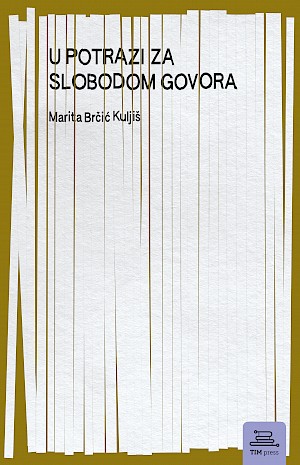
In Search of Freedom of Speech by Marita Brčić Kuljiš is an original and theoretically significant contribution to contemporary debates on freedom of speech in the digital age. By connecting classical political-philosophical thought with current phenomena such as hate speech, disinformation, cancel culture, and algorithmic surveillance, the author develops an innovative hermeneutic framework for understanding the crisis of public discourse in democratic societies.
A particular strength of the book lies in its reinterpretation of the ancient concepts of isegoria and parrhesia, through which it examines the boundaries of free expression, responsibility, and truth-telling in the contemporary public sphere. The author also reflects on the relationship between artificial intelligence, digital platforms, and freedom of speech, raising important questions about censorship, autonomy, and the future of democratic communication.
Combining philosophical depth, an interdisciplinary approach, and a clearly articulated authorial perspective, this book represents a valuable contribution to political philosophy, media ethics, and the philosophy of technology.
* * *
Freedom of speech carries a message that concerns the public interest. For this reason, it must take place within a public space that includes both the speaker and the listener—that is, an audience. If there is no one to hear the speech, it fails to fulfil the function that freedom of speech is meant to serve, and it can hardly be described as the effective exercise of the right to free expression. If someone climbs to the top of a skyscraper and shouts at the top of their lungs, „Down with the government!“, but is heard only by the birds flying overhead, has the right to freedom of speech truly been exercised? Although such an act is permitted, it does not in itself fulfil the essential purpose of freedom of speech, which is to ensure that one's voice, opinion, or argument is heard and that a message is communicated to others.
* * *
Freedom of speech should be responsible, well-reasoned, and grounded in clearly articulated values. It should promote dialogue, embody responsibility toward one's interlocutor, and reflect a shared responsibility for preserving the public sphere itself. Hate speech negates all of these principles because its very essence is hatred, which can never constitute an articulated or acceptable value, nor even a legitimately expressed opinion.
I do not believe that restricting hate speech threatens freedom of speech. On the contrary, I believe that reducing hate speech in the public sphere would further strengthen freedom of speech, which today—particularly in online environments—is often self-censored precisely because of fear of hate speech. Where fear prevails, there can be no freedom.
- ISBN: 978-953-369-075-9
- Dimensions: 155x230 mm
- Number of pages: 272
- Cover: paperback
- Year of the edition: 2026